

If a contract pays out when Apple beats its iPhone revenue target, are you trading or betting?
Honest answer: mechanically, it’s close to the same thing. Legally and structurally, it isn’t. That gap is the whole story behind the current wave of event-contract launches, and it’s why prediction markets explained in plain terms matter to anyone who follows gambling markets. Robinhood Markets (NASDAQ: HOOD) said it will become the first retail broker to list Cboe Global Markets (BATS: CBOE) event contracts tied to corporate earnings reports and other company data points, pending regulatory approval. A product that looks a lot like a bet is arriving inside a mainstream brokerage app, under securities regulation rather than gambling regulation.
What exactly did Robinhood and Cboe announce?
At Robinhood’s third annual HOOD Summit in Houston, the broker confirmed it would be first to carry Cboe’s event contracts linked to corporate earnings and similar data points. Cboe said the derivatives could launch on Robinhood at some point in October, subject to regulatory approval, which would put them in play around the start of third-quarter earnings season in the second week of October.
The groundwork was laid in July, when Cboe asked regulators to approve binary derivatives tied to 100 key performance indicators across 23 public companies. The expected roster includes Apple, Coinbase Global, SpaceX, Tesla and Robinhood itself. Both Cboe and Robinhood are waiving fees on the KPI event contracts through the end of the year, which tells you how much they want volume and habit-formation early.
The summit also brought news of weekend trading in selected equities and ETFs, plus plans to give clients access to AI trading bots. The Cboe deal is the one worth watching, though, because prediction markets are the fastest-growing business line in Robinhood’s history.
How does a binary event contract actually work?
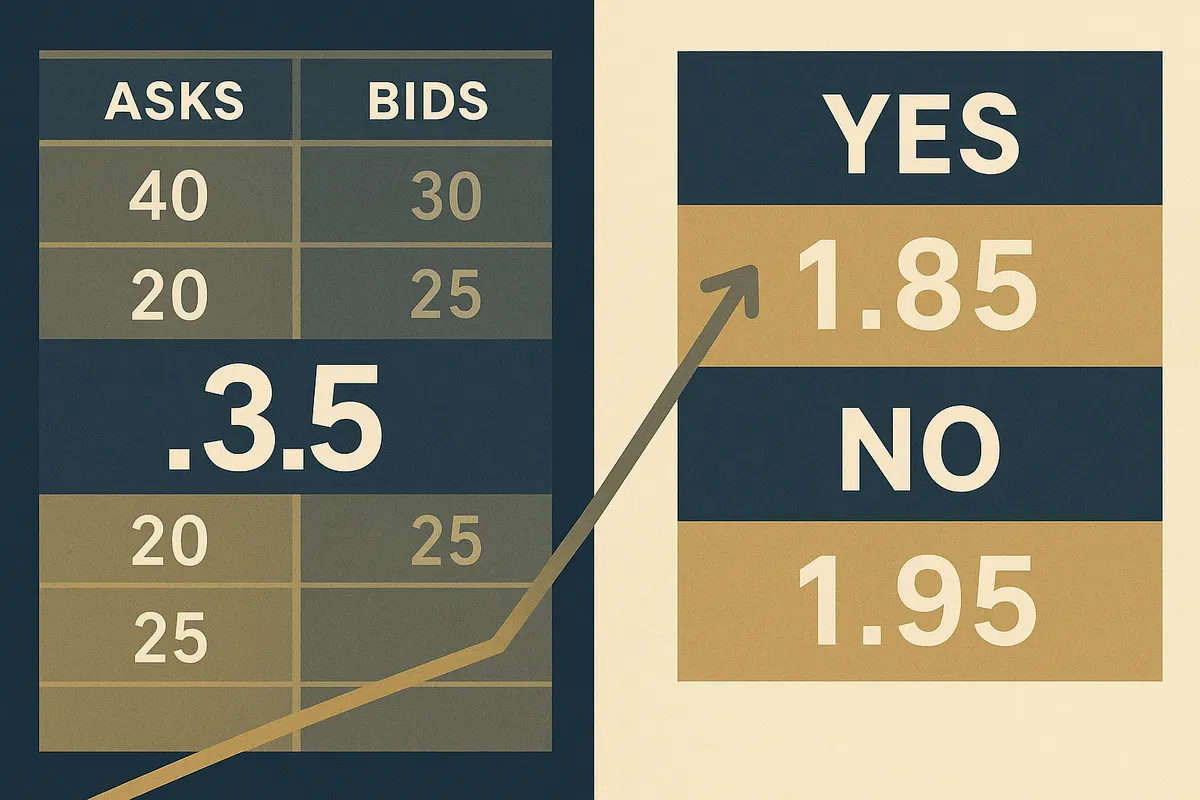
A binary event contract resolves to one of two values: full settlement value if the stated outcome happens, or nothing if it doesn’t. The price you pay sits somewhere between those two poles, and that price is the market’s implied probability. If a contract trades at 35 cents on the dollar, the market is pricing roughly a 35% chance of the event occurring.
That should feel familiar to anyone who has converted decimal odds into implied probability. Odds of 2.86 imply about 35% (1 ÷ 2.86). Same arithmetic, different wrapper.
What’s genuinely new in the Cboe product is the subject matter. Most corporate event contracts on existing prediction markets reference stock price moves or corporate actions such as mergers, acquisitions or IPO filings. Kalshi traders, for example, at one point priced around an 80% chance of a Caesars acquisition within the year. Cboe’s KPI contracts instead target discrete operational numbers: iPhone sales, SpaceX rocket or satellite launches, deliveries of specific Tesla models. These are the kinds of data points that previously only mattered to equity analysts.
Why does the regulator matter so much here?
Because it changes what the product legally is. Cboe has been explicit that its KPI binary options are SEC-regulated securities traded on its registered US securities exchange, and it has framed that as a deliberate point of difference from similar event-based contracts traded on designated contract markets (DCMs). In Cboe’s words, these products should sit within “the transparency, oversight and investor protections of the U.S. securities markets,” including the benefit of federal preemption of state securities registration requirements.
Read that last clause slowly, because it’s the commercially important one. Much of the friction around sports event contracts has come from state-level gambling regulators arguing that an outcome contract on a football game is a wager wearing a suit. A securities-exchange framing is an attempt to route around that argument entirely. Whether it holds up is a matter for regulators and courts, not for marketing decks.
Betting versus trading: where is the real line?
There’s no single clean dividing line, but there are consistent structural differences worth knowing before you compare a sportsbook ticket to an event contract.
| Feature | Sportsbook bet | Binary event contract |
|---|---|---|
| Counterparty | The operator takes the other side | Another market participant, via an exchange |
| How the venue earns | Built-in margin in the odds (overround) | Commissions, spreads or fees; sometimes waived promotionally |
| Price movement | Operator sets and adjusts odds | Order flow sets the price continuously |
| Exit before resolution | Partial, via cash-out if offered | Sell the position at the prevailing market price |
| Oversight | Gambling regulators, state by state | Financial regulators (SEC or CFTC, by venue) |
| Typical tax and reporting treatment | Gambling winnings rules | Investment or derivatives rules |
The point that gets lost in the semantics: in both cases you are paying for exposure to an uncertain outcome, and in both cases the venue extracts a cost. An exchange model can mean tighter effective pricing than a bookmaker’s margin, but it is not a free ride, and it does nothing to make a losing position less of a loss. The fee waiver running to year end makes the current pricing unusually friendly, which is a promotional condition, not a permanent feature.
Why are brokers chasing outcome-based products now?
Growth, mostly. Prediction markets have been the fastest-growing part of Robinhood’s business, driven heavily by customers buying sports event contracts. That is a telling detail on its own: a stock-trading app found that a meaningful slice of its user base wanted outcome-based positions on games.
The ceiling for that growth has drawn serious attention. Bernstein analysts have projected Robinhood’s prediction market revenue could reach $1.7 billion in 2028. Forecasts are forecasts, but numbers of that size explain the product velocity.
The KPI contracts are a logical next move because they reach back toward what brought most customers to a brokerage in the first place, which is trading financial markets. And the institutional push is running in parallel: Polymarket hired a former Goldman Sachs partner to lead institutional growth, part of a wider effort across regulated prediction platforms to find volume beyond sports.
What does this mean in practice for the iGaming world?
Three practical consequences stand out.
- A new competitor for the same attention. Someone who wants a position on a discrete, short-dated outcome now has a brokerage-app option that settles on an earnings release rather than a final whistle. Earnings prediction markets create a recurring calendar of events four times a year per company, with no sports season to wait for.
- Regulatory pressure flows both ways. If outcome contracts on company metrics sit comfortably under securities oversight, licensed operators will reasonably ask why near-identical exposure faces a very different compliance burden. Expect that argument to be made loudly, and expect state regulators to push back.
- The consumer-protection questions change shape. Event contracts are not advertised with an RTP figure, and there is no published house edge to inspect. The cost sits in the spread, the fees and the accuracy of your own probability estimate. Resolution rules, the data source used to settle a contract and what happens in an ambiguous case all become things a user has to actually read.
What should you check before putting money into event contracts?
Start with the resolution criteria. A contract on “iPhone sales” is only as good as the specific metric, the reporting source and the cut-off it names. Then look at liquidity, because a thin market means you may not get the exit price you expect. Check the fee schedule and when the promotional waiver ends. Finally, be clear about tax treatment, which follows the product’s legal classification and can differ sharply from how gambling winnings are handled where you live.
And keep the framing honest. Dressing an uncertain outcome in exchange infrastructure does not remove the risk of losing the full amount you paid. Binary contracts expire worthless when you’re wrong, which makes them an easy place to churn capital quickly. If you find yourself trading outcomes to recover a loss, or staking money you need, the same tools that apply to gambling apply here: set hard limits in advance, take cool-off periods, and seek support if control starts slipping. Nothing in a regulated wrapper makes an outcome predictable.
The detail worth remembering
A broker with tens of millions of accounts listing SEC-regulated binary contracts on iPhone sales and Tesla deliveries is a bigger shift than any single sports market launch. It moves outcome based betting from a standalone category into the default financial app on a phone, with fees waived to encourage the first trade. Watch the approval timeline, watch whether the KPI contracts find real volume once earnings season arrives, and watch how state regulators respond to the federal preemption argument. Those three threads will decide whether this is a lasting new product class or a well-timed experiment.
Leave a comment