

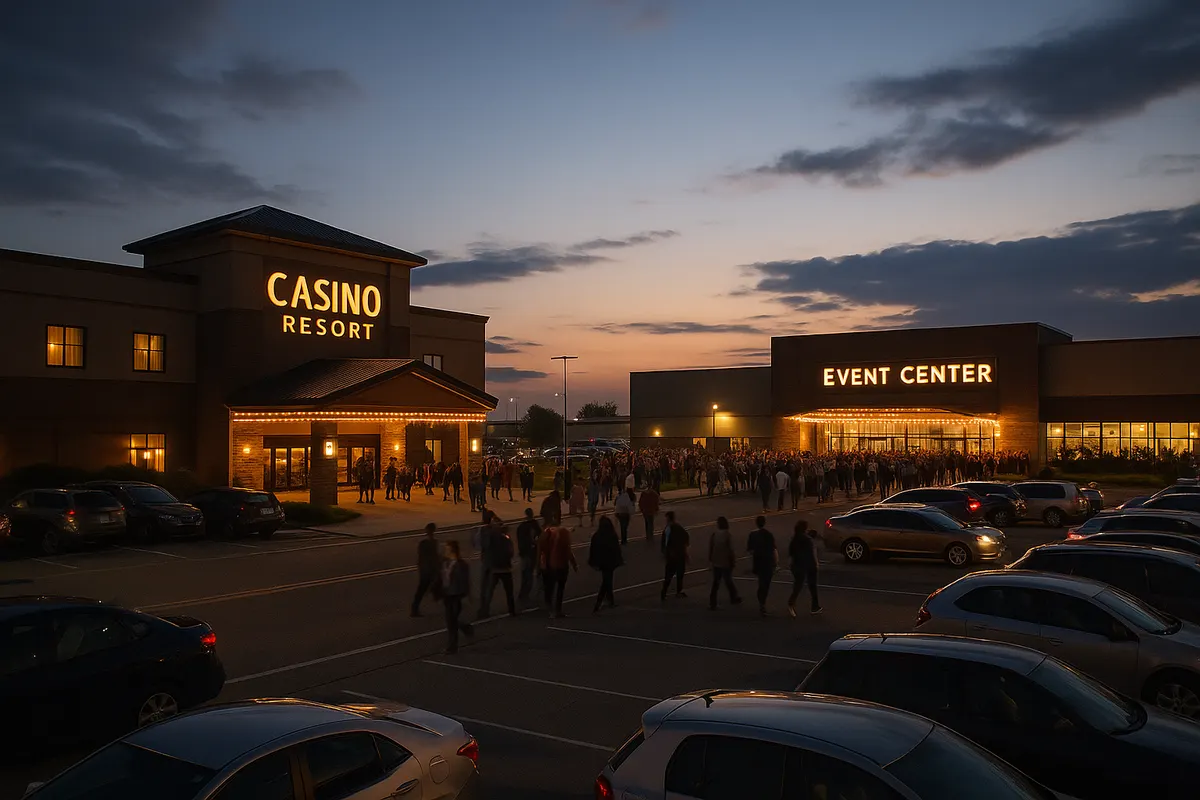
Casino promotions do not appear at random. That is the myth worth busting before anything else: the bigger welcome offer, the doubled comp points, the “event weekend only” package are not generosity, and they are not luck of the draw. They are scheduled, budgeted and modelled months in advance, and the single biggest trigger is casino event traffic, a predictable spike in people walking through the doors.
Once you understand why a venue spends more to get your attention on a busy weekend than on a quiet Tuesday, you can start reading the promotional calendar the way the marketing department does. That is the practical skill this article is about.
Why casino event traffic is worth more than the gaming floor alone
A big event near a casino does three things at once: it raises footfall, it lengthens the average stay, and it pulls in people who have never set foot in the building before. Each of those has a different value to the operator, which is why the response is never just “put on more dealers”.
Nebraska’s Grand Island Casino Resort gave a clean example of the pattern. Elite Casino Resorts, working with the Hall County Livestock Improvement Association, opened the $185 million property at Fonner Park in April 2025, directly across from the Pinnacle Bank Expo Center. When a presidential visit to the Expo Center was announced, the resort’s general manager, Vince Fiala, told local broadcaster KSNB that room bookings had doubled on the back of the announcement alone, and that he expected a full house with visitors arriving from across the state and beyond. It was the first stop by a sitting US president in Grand Island since George W. Bush in 2006.
Revenue that has nothing to do with the slots
The Grand Island property is 37,000 square feet with roughly 750 slot machines, 20 table games, a poker room and a sportsbook. It also has a 162-room hotel, indoor and outdoor pools, three restaurants and bars, and a spa and fitness centre. That second list is where an event crowd spends first.
Rooms, food, drink, parking and spa bookings are non-gaming revenue, and they behave differently from the gaming floor. Gaming revenue is a statistical outcome, the house edge applied to total wagers over time. A sold-out hotel is contracted revenue the moment the card is charged. For a management team, an event that fills 162 rooms is a far more certain win than an event that merely puts more hands on the tables.
The multiplier effect of one busy night
The real prize is what happens after the event. Through August of its first year, Grand Island won a little over $44 million from slots, tables and sports betting, ranking third among Nebraska’s five racetrack casinos behind WarHorse Omaha at $80.5 million and WarHorse Lincoln at $63.5 million. A property in that position does not need one great night. It needs a share of the regional audience that currently drives somewhere else.
So a single event gets treated as a sampling exercise. Each first-time visitor is a chance to capture an email address, a loyalty sign-up and a reason to come back, and the industry term for the value of that relationship over time is player lifetime value. That is the figure that justifies the marketing spend, not the takings on the night.
The casino marketing tactics that surround a big event
Once a date is locked in, operators run a fairly consistent playbook. Knowing its stages tells you when offers go live and when they quietly disappear.
The pre-event marketing blitz
- Paid push into the catchment area, usually geo-targeted at the towns the event will draw from, often starting the week the event is announced.
- Database reactivation: emails and app notifications to lapsed players, since a reason to visit is the cheapest hook a marketer ever gets.
- Loyalty sign-up incentives at the door, because an unregistered visitor is a one-off and a registered one is a contactable audience.
- Staffing and capacity planning: more dealers, longer kitchen hours, extra security and sometimes additional policing arrangements, all of which push up the cost base and have to be earned back.
Dynamic pricing and premium packages
Rooms are the clearest signal. When occupancy forecasts jump, rates rise, minimum-night stays appear, and cheap midweek deals vanish from the booking engine. Bundles replace them: room plus dinner credit, room plus event shuttle, room plus a tournament entry. Restaurants shift to set menus and reservations. This is straightforward revenue optimisation, and it is also why an event weekend can be the worst time to buy a hotel room and one of the better times to collect a gaming-side offer. The two move in opposite directions on purpose.
Why casino bonus timing follows the event calendar
Promotional budgets are set against expected player acquisition. If a venue, or an online brand sponsoring the same moment, expects a surge of new registrations, the modelled lifetime value of that cohort goes up, and the cost it is willing to pay per new player goes up with it. A bigger bonus is simply a higher bid.
The second driver is competition for attention. During a major sports final, a festival or a high-profile visit, every operator targeting that audience is bidding for the same eyeballs at the same time. Matching the market becomes the price of being noticed, which is why offers cluster rather than stagger. You see the same effect online around tournaments, holiday weekends and big game launches.
Worth saying plainly: none of this changes the mathematics of the games. The house edge on a slot with 96% RTP is 4% whether you play on the quietest Tuesday of the year or the busiest night in the building’s history. Events change the price of the promotion, not the odds.
What event-driven casino resort promotions actually look like
Bonus multipliers and enhanced offers
The usual shapes are a temporarily larger match on a first deposit, a higher cap on an existing offer, multiplied comp or tier points on the gaming floor, free-play vouchers tied to a same-day event ticket, and prize draws that need entry on the night. Online, expect boosted odds, cashback windows and tournament leaderboards pegged to the event.
Enhanced does not mean better. A 200% match with 50x wagering can be worth less than a 100% match at 25x. Here is how to read each type:
| Promotion type | What the operator wants from it | What to check first |
|---|---|---|
| Larger deposit match | New registrations during peak attention | Wagering requirement, max bet while active, max cashout |
| Comp or tier point multiplier | More time on the floor from existing members | Which games qualify, and the real cash value of a point |
| Free play tied to an event ticket | Converting event crowds into players | Expiry window and whether winnings are cash or more free play |
| Tournament or leaderboard entry | Repeat visits across several days | Field size, buy-in cost and how prizes are split |
| Room and dining bundle | Non-gaming revenue and longer stays | Whether the bundled price beats booking items separately |
Exclusive access and VIP treatment
Higher-value players get a different version of the same event: reserved seating, hosted lounges, shuttle service, comped rooms on dates that are otherwise sold out, and invitation-only tournaments. The trade is consistent play recorded on a loyalty card. If you are a modest recreational player, a lot of this tier is not aimed at you, and chasing it by raising your stakes is exactly the behaviour the structure is designed to encourage. Our guide to reading bonus terms covers the wagering mechanics in more depth.
How to time event driven casino visits, step by step
- Find the local event calendar, not the casino’s. Convention centres, arenas, racetracks and expo venues publish schedules months out. A casino sitting across the road from an expo centre inherits every date on that list.
- Watch the announcement window. Promotions usually go live within days of a big event being confirmed, and the earliest versions tend to carry the lightest conditions. Late offers are often capacity-management offers instead.
- Get on the mailing list before you want anything. Targeted offers go to the database first. Signing up a month ahead costs nothing and puts you in the segment that receives them.
- Compare the offer against the ordinary one. Screenshot the standing bonus terms now, so you can tell a genuine upgrade from a repackaged baseline when the event version appears.
- Decide whether you want the crowd or the aftermath. Event weekends bring queues, higher table minimums, fewer open seats and peak room rates. The week after often brings discounted rooms and reactivation offers aimed at people who did not show up. If value is the point, that quieter window frequently wins.
- Set your budget before you walk in. Decide the amount and the time in advance, and treat any bonus as a discount on entertainment you had already chosen to buy, not as extra money.
That last step matters more than any of the timing. A promotion lowers the cost of play a little; it does not turn a negative-expectation game into a positive one. Use deposit and loss limits, keep sessions bounded, and step away from the floor if you are chasing. If gambling stops feeling like entertainment, operators are required to offer cool-off and self-exclusion tools, and national helplines exist in most markets.
Common questions
How do casinos benefit from events?
Through footfall, occupancy and exposure. An event fills hotel rooms and restaurants with near-certain revenue, raises spend per visitor during longer stays, and introduces the property to people who would not otherwise visit. The lasting benefit is the loyalty sign-ups and contact details collected on the night.
Why do casino bonuses increase during events?
Because expected player acquisition rises, and operators bid more for each new sign-up when they think those players are worth more over time. Competition for attention during a crowded moment pushes the same offers higher still.
When do casinos offer the best promotions?
Typically in the run-up to a confirmed high-traffic date, and again in the quiet period afterwards when the goal shifts to bringing lapsed players back. The headline figure is biggest during the event window, but the terms are often friendlier outside it.
What events boost casino traffic the most?
Anything that draws a large crowd to a venue near the property: major sports fixtures, concerts and festivals, conventions and expos, race meetings, and one-off civic or political occasions like the presidential visit that doubled room bookings at Grand Island Casino Resort.
Leave a comment