

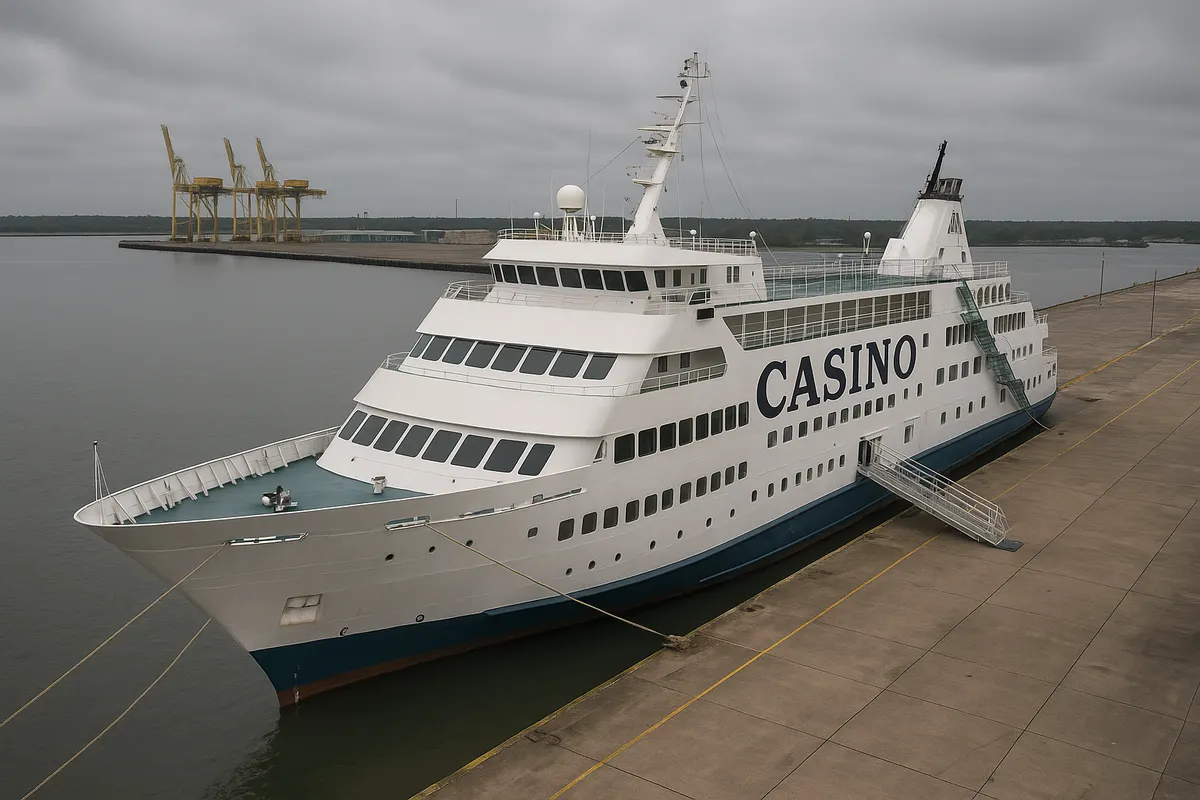
A casino cruise ship is a gaming floor that has to pass a marine survey
That is the one-line definition, and it is also the whole problem. Casino cruise ship operations depend on two things working at once: a licensed-or-permitted gambling product, and a seaworthy vessel certified to carry passengers. Lose the second and you lose the first, instantly, with no fallback. A land casino with a broken chiller closes a wing. A casino boat with a mechanical issue closes the business.
Victory Casino Cruises in Florida is living that right now. After its Sept. 28 sailings, the company pulled Victory I, its only ship, out of service for what it described as an extended dry dock. Voyages stopped. Paid reservations and deposits are being refunded, and future bookings are on hold until the work is finished. Employees who answered questions about their status said they had been placed on furlough, which means temporary mandatory leave without pay, with the option to apply for unemployment benefits and continued health coverage through COBRA.
Captain Tim, in a Facebook message to customers, said the company had hoped to resume sailing sooner but that “additional necessary work has extended our time out of service.” The company also made clear what the dry dock is not: it is mechanical work, not a refresh. No new carpet, no new lighting, no new slot machines. Customers will come back to the same floor they left.
The numbers behind a single-ship operation
Victory has sailed from Terminal B-2 at Port Canaveral for 16 years and says it has served more than three million gamblers over that run. Before the dry dock, Victory I ran twice a day, Tuesday through Sunday, with gambling opening once the ship reached international waters, typically about 45 minutes after leaving the dock. Boarding was $25 per person, with discounts for groups of 10 or more.
The gaming floor itself is substantial for a day boat: more than 600 slot machines plus live dealer blackjack, craps, roulette, poker and baccarat, along with bingo and sports betting. Alcoholic drinks are free while you gamble, and smoking is confined to the open air on Deck 4.
Run the company’s own figures through the pre-dry-dock schedule and you get a rough sense of scale. Two sailings a day, six days a week, is somewhere around 600 departures a year. Three million passengers across 16 years averages out near 185,000 a year, which lands at roughly 300 passengers per sailing on average. Treat that as a back-of-envelope figure rather than a reported one, but it tells you the shape of the business: high frequency, modest headcount per trip, thin margin for downtime.
Why the gaming stops the moment the hull leaves the water
Two separate constraints stack on top of each other here, and it helps to keep them apart.
The first is maritime. Passenger vessels are inspected and maintained to schedules set by regulators and classification rules, and the parts that matter most, the hull, propulsion, shafts and valves below the waterline, can only be properly surveyed and repaired with the ship out of the water. Dry dock is not optional housekeeping. Once a vessel is up on blocks and opened up, the scope of work can grow, which is exactly what Victory described when it said extra necessary work had pushed the timeline out.
The second is jurisdictional. On a day-cruise casino boat, the gambling is legal because of where the ship is, not where it departed from. Victory’s casino opened only after the ship reached international waters, about 45 minutes out. US territorial waters extend 12 nautical miles from the coast, and beyond that line the onboard gaming product becomes available. That is the whole premise of the “cruise to nowhere” format: sail out, gamble, sail back.
Put those together and you get a business with no partial operating mode. A docked casino boat cannot open a reduced floor, cannot run the slots at the terminal, cannot sell bingo in the parking lot. Revenue goes to zero on day one of the dry dock and stays there until the ship is certified to sail again.
Three ways to float a casino, compared
The floating-casino label covers very different business structures, and they absorb a maintenance shock in very different ways. Here is how they stack up.
| Model | How gaming is enabled | Effect of a dry dock | Downtime resilience |
|---|---|---|---|
| Single-ship day cruise (Victory I) | Sails past territorial waters; casino opens offshore | All revenue stops; bookings refunded; staff furloughed | Lowest. One hull is the entire company |
| Multi-vessel day-cruise fleet | Same offshore mechanic, multiple hulls | One ship out, others keep sailing; staff can be redeployed | Moderate. Depends on spare capacity at the same port |
| Casino aboard an itinerary cruise line | Casino opens once the ship is clear of port-state restrictions | One ship’s casino offline; fleet revenue largely unaffected | High. Dry docks are planned years ahead and staffed around |
| Land-based or dockside casino | Licensed at a fixed location | No marine survey requirement; closures are localised | Highest. Can usually trade through most repairs |
The pattern is not about size of floor. Victory I’s 600-plus machines would be a respectable regional casino on land. The difference is redundancy. Fleet operators treat dry dock as a line item on a multi-year calendar, slot it into a shoulder season, and move crew and players to other ships. A single-ship operator treats it as an existential event, because there is nowhere to move anyone.
What the furloughs tell you about cruise ship casino jobs
This is the part the industry tends to gloss over. Dealers, slot techs, cage staff, bar and deck crew on a day boat are tied to a departure schedule, not to a building. When sailings stop, scheduled shifts stop with them, and a furlough is legally distinct from a layoff: no pay, employment relationship intact, benefits sometimes continued, unemployment claims and COBRA available in the meantime.
If you are weighing a casino job at sea against one on land, that asymmetry is worth pricing in. Tips on a busy offshore floor with free drinks and a captive audience can beat a comparable land role. The trade is schedule risk you do not control, driven by engineering timelines rather than customer demand. Victory’s customers got refunds. Its staff got an open-ended wait.
What it means in practice for players and operators
For players, three practical habits come out of this story. Pay by a method you can trace and refund, since reservations on a vessel are a claim against a schedule, not a seat in a building. Do not carry loyalty points, comps or stored balances you would be unhappy to leave idle for an unknown number of weeks. And check whether an operator runs one ship or several before planning anything around a sailing date.
For operators and anyone reading the sector as an investment, the lesson is blunter. The offshore gambling vessel model buys access to a gaming product without a land licence, and pays for it in operational fragility. Capital expenditure on a hull is lumpy, unplanned scope creep is normal in shipyards, and the moment the ship is out of the water the revenue line is flat. That is a very different risk profile from a dockside casino that mainly worries about footfall and regulation.
None of this changes the maths on the games themselves. Whether a slot sits on a ship 13 nautical miles offshore or in a building off the interstate, the RTP is set by the machine and the house edge does not care about the view. Decide your budget before you board, treat the $25 boarding fee and the free drinks as entertainment costs, and use deposit or session limits where the operator offers them. If gambling stops feeling like entertainment, support services are available in most jurisdictions.
Frequently asked questions
Why can’t a casino cruise ship run its casino while in dry dock?
Because the gaming depends on the sailing. On a day-cruise boat, gambling opens only after the vessel clears territorial waters, so a ship sitting on blocks in a shipyard has no legal or physical way to open its floor. The casino is a function of the voyage, not the building.
How far out does a casino boat have to sail before gambling starts?
Past the territorial sea, which extends 12 nautical miles from the coast. On Victory I, gambling typically began about 45 minutes after departure from Port Canaveral, once the ship reached international waters.
Do casino ship workers get paid during an extended dry dock?
Not during a furlough. Victory Casino Cruises staff who responded to questions said they had been furloughed, which is unpaid mandatory leave. Furloughed workers can apply for unemployment benefits and continued health coverage through COBRA, and some employers maintain other benefits.
Was the Victory I dry dock a refurbishment?
No. The company said the work concerns the ship’s mechanical systems and is not cosmetic, so passengers should not expect new carpet, lighting or gaming machines when sailings resume.
Leave a comment